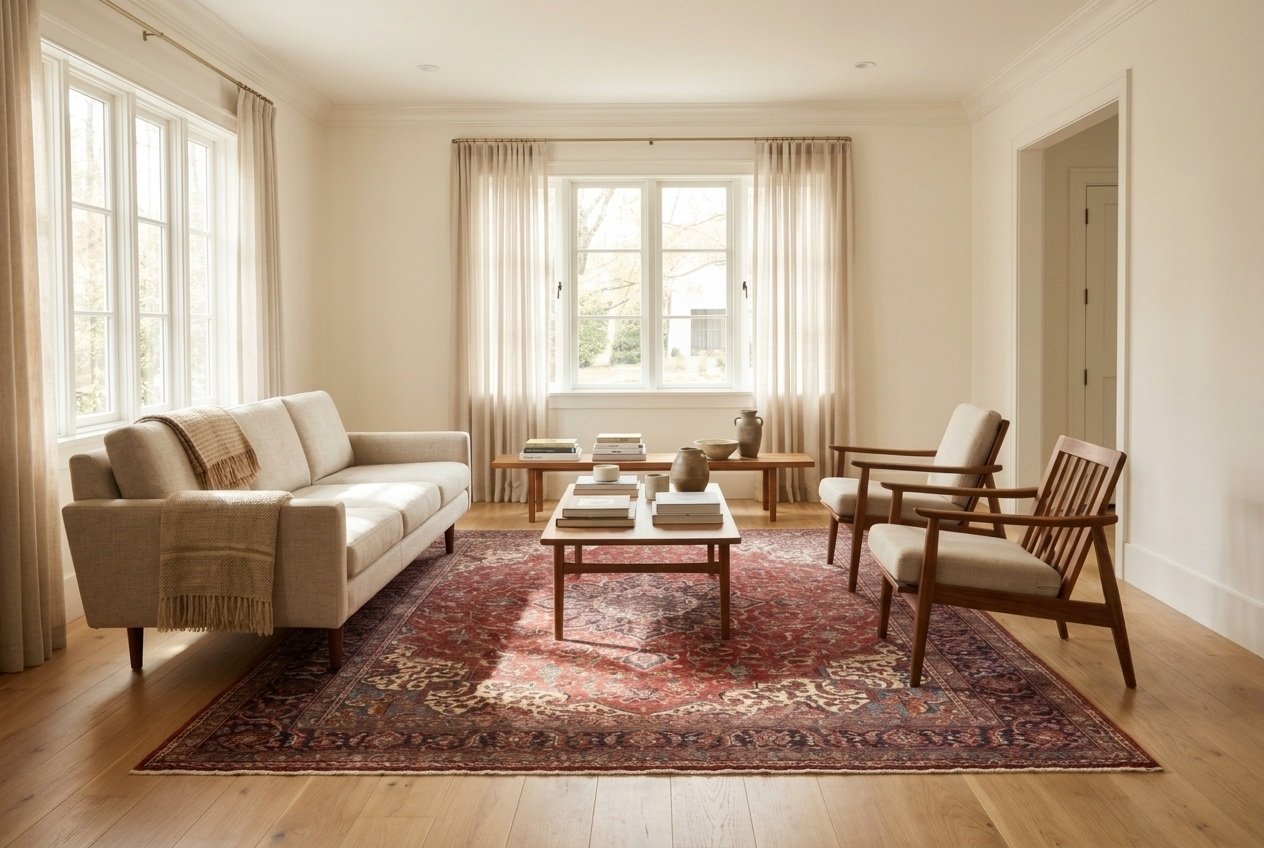
Persian and Turkish rugs are the two most popular rug styles in Pakistan, and they are easy to confuse. In short: Persian rugs are known for flowing floral patterns, central medallions and very fine detail, while Turkish rugs lean toward bolder geometric designs and modern looks. This guide explains the real differences, how to judge quality, and which one suits your home.
Persian vs Turkish Rugs at a Glance
| Persian rugs | Turkish rugs | |
|---|---|---|
| Origin | Iran (Persia) | Turkey (Anatolia) |
| Typical designs | Curved florals, central medallions, detailed borders | Geometric shapes, bold motifs; many modern and abstract styles |
| Hand-knot type | Asymmetrical (Persian or Senneh) knot | Symmetrical (Turkish or Ghiordes) knot |
| Look and feel | Formal, classic, very detailed | Versatile, from traditional to contemporary |
| Best for | Drawing rooms, formal lounges, dining rooms | Family lounges, bedrooms, modern interiors |
1. Design and Patterns
Persian designs usually build around a central medallion with curved vines, flowers and detailed borders. Many classic Persian patterns are named after the cities that made them famous, such as Tabriz, Kashan and Isfahan.
Traditional Turkish rugs use more geometric and stylised shapes. Today’s Turkish factories also make a large range of modern rugs: abstract, minimalist and distressed vintage looks that suit contemporary homes.
2. Knots and Construction
In handmade rugs, the main technical difference is the knot. Persian weavers traditionally use an asymmetrical knot, which allows tighter curves and finer detail. Turkish weavers use a symmetrical double knot, which makes a very strong, durable pile.
Both styles are also made by machine. Machine-made Persian and Turkish design rugs give you the same look at a much lower price, which is why they are the most common choice for Pakistani homes.
3. What “Reeds” Mean
When shopping for machine-made rugs in Pakistan, you will hear sellers talk about reeds (for example 500, 700, 1200 or 1500 reeds). The reed count shows how dense the weave is. A higher reed count usually means more detail in the design, a smoother finish and a heavier rug. Lower reed counts are lighter and more budget-friendly.
4. Materials
Handmade Persian and Turkish rugs are usually made from wool, sometimes with silk highlights. Machine-made rugs use materials such as polypropylene, polyester or viscose (“bamboo silk”), which give a soft sheen at an affordable price. Ask the seller about the material, as it affects feel, shine and cleaning.
5. Price
Price depends far more on how a rug is made than on whether it is Persian or Turkish. A handmade rug takes months to weave and costs much more than a machine-made one of the same size. Size, reed count and material also change the price. If you are on a budget, a machine-made Persian or Turkish design rug gives the look for a fraction of the cost.
Which Should You Choose?
- Choose a Persian rug if you want a classic, formal look for a drawing room or dining room, or you love detailed florals and medallions. Browse our Persian rugs or, for handmade pieces, our authentic Persian rugs.
- Choose a Turkish rug if you want a modern or geometric design, a rug for a busy family room, or something that matches contemporary furniture. See our Turkish area rugs.
- Want something one of a kind? Look at our handmade rugs.
How to Care for Your Rug
- Vacuum regularly, but avoid the fringes.
- Rotate the rug every few months so it wears evenly.
- Blot spills straight away with a clean cloth; don’t rub.
- Keep it out of strong direct sunlight to prevent fading.
- Use a rug pad on marble or tile floors to stop slipping.
Frequently Asked Questions
What is the difference between Persian and Turkish rugs?
Persian rugs usually have curved floral designs and central medallions, while Turkish rugs often use bolder geometric patterns and modern styles. In handmade rugs, Persian weavers use an asymmetrical knot and Turkish weavers use a symmetrical knot.
Are Persian rugs better than Turkish rugs?
Neither is better in general. Quality depends on how the rug is made, its density and its materials. Choose by the design and feel you want for your room.
Which rug is best for a drawing room?
A Persian design rug suits a formal drawing room. For a modern drawing room, a Turkish contemporary rug also works well.
Do you deliver Persian and Turkish rugs across Pakistan?
Yes. Quetta Carpets offers free delivery across Pakistan, ships worldwide and offers cash on delivery.
Shop Persian and Turkish Rugs at Quetta Carpets
Visit our showrooms on Saidpur Road, Rawalpindi or Golra Furniture Market, Islamabad, browse the full collection online, or message us on WhatsApp for help choosing the right rug.